

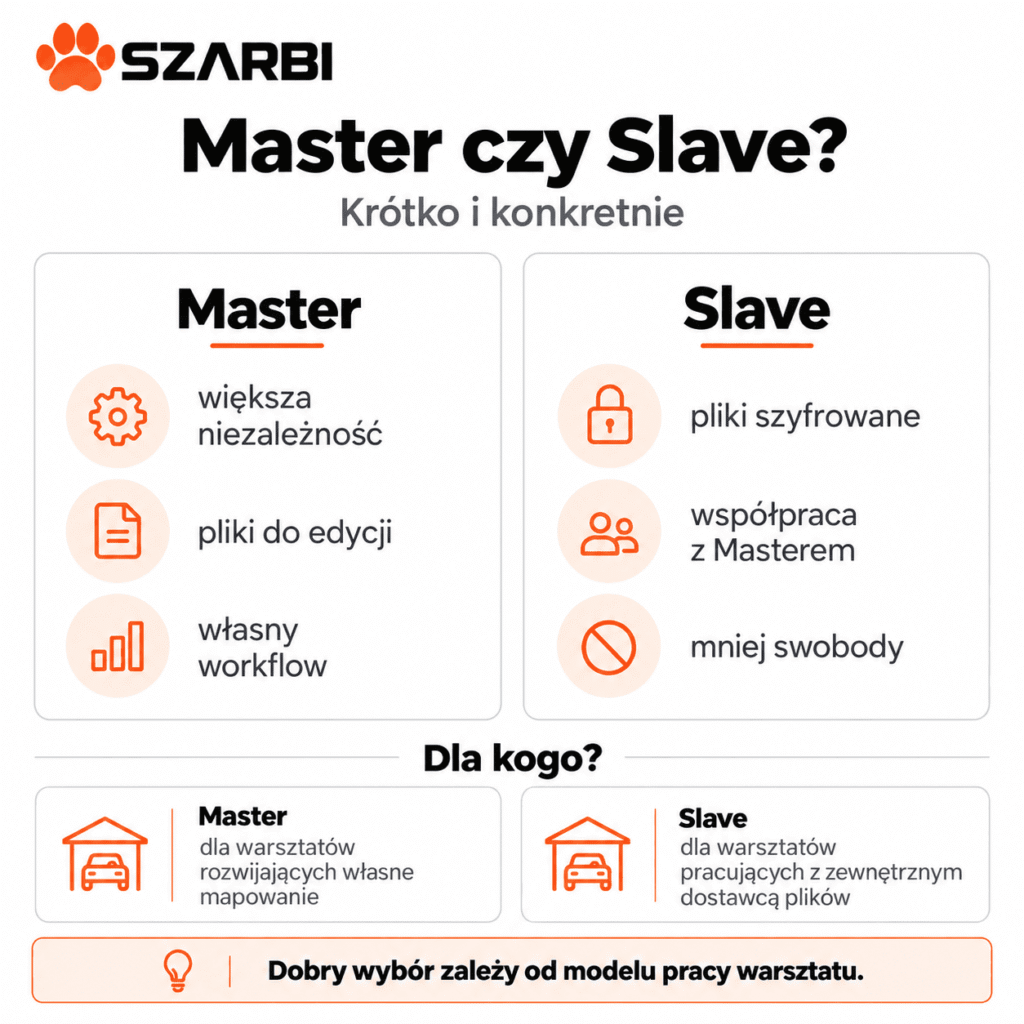
Master or Slave tool? This is not a choice between a “better” and a “worse” device. The difference is primarily about who can work on the ECU or TCU file that has been read and what the workflow in the workshop looks like. A Master gives you access to a file intended for further editing, whereas a Slave relies on cooperation with an assigned file provider.
Key information:
- A Master gives you greater independence when working with ECU and TCU files. In systems such as AutoTuner, you can edit an unencrypted file yourself or send it to a calibration provider of your choice. [1]
- A Slave works on encrypted files. The file is linked to a specific Master, which is responsible for decrypting it and preparing the modified version. [1][2]
- A Slave does not necessarily have weaker communication capabilities with the ECU. In many systems, Master and Slave versions use the same families of OBD, Bench and Boot protocols. The difference mainly concerns working with the file. [1][4]
- A Master does not replace map editing software or a calibrator's expertise. Simply having access to the binary file does not mean you can safely modify the calibration.
- When choosing, the workshop's entire business model matters: the cost of the tool, software, files, licences, subscriptions and any later migration from Slave to Master.
What is the difference between a Master and a Slave tool?
The key difference between Master and Slave concerns access to the file read from the ECU.
In AutoTuner, the Master version provides an unencrypted file that you can modify yourself in compatible software or pass on to any file provider. A Slave reads and writes encrypted files, which can be processed by the Master to which the device has been assigned. [1][2]
Magic Motorsport uses a similar model in its FLEX system. The manufacturer states that a Slave user works on encrypted files and has no access to their contents, while the modification is handled by the assigned Master. [4]
Alientech describes KESS3 in a similar way: a Master can work with the read file independently, while a Slave user sends the file to their Master and receives a ready-to-write version. [5]
| Feature | Master | Slave |
|---|---|---|
| File access | unencrypted / intended for further work | encrypted |
| Independent editing | possible with the appropriate software | no |
| File provider | you can choose different ones | usually the assigned Master |
| Own calibration workflow | yes | limited |
| Knowledge required to get started | more | less |
| Dependence on an external company | less | more |
| Ability to build a Slave network | depending on the ecosystem – yes | no |
Does a Master support more ECUs and TCUs than a Slave?
You should not assume that the Master version automatically supports more ECUs than the Slave. These are two separate issues.
The range of compatibility depends primarily on:
- the tool manufacturer,
- the protocols purchased,
- active packages,
- the specific ECU or TCU,
- the available OBD, Bench or Boot mode,
- the tool's software version.
A good example is FLEX. In the documentation for new protocols, the manufacturer regularly lists the same solutions for both Master and Slave packages. For instance, support for certain TCU controllers may be available in both the FLS0.2M configuration and its corresponding FLS0.2S. [6]
Similarly, AutoTuner offers a single ECU/TCU communication environment with OBD, Bench and Boot, and the choice between Master and Slave primarily determines how you work with the file afterwards. [1]
That's why the question shouldn't just be "Master or Slave?", but also:
"Which ECUs, TCUs and protocols does the specific configuration I'm buying support?"
Szarbi expert advice: don't pay extra for a Master just because it sounds more professional. First, determine who will be doing the calibration and whether you actually need access to unencrypted files.
When does a Slave programmer make sense for a workshop?
A Slave makes sense when you want to read and write ECUs but plan to outsource calibration work to an external specialist.
This is a common model when starting to develop ECU services.
In this setup, the workshop can be responsible for:
- vehicle diagnostics,
- identifying the ECU or TCU,
- correct reading,
- sending the file to the Master,
- receiving the modified version,
- writing to the ECU,
- checking parameters after the modification.
You don't have to immediately invest time in learning map structures, torque strategies, the load model, boost control or temperature-dependent limiters.
However, this doesn't mean the Slave handles the entire process automatically.
You still need to know how to handle the ECU properly, ensure a stable power supply, identify the correct OBD, Bench or Boot method and assess the vehicle's condition before writing.
What are the limitations of a Slave?
The biggest limitation is dependence on the Master.
If a customer's car is on the bay and the file needs correcting, turnaround time also depends on the availability of the external supplier. So it's not only their expertise that matters, but also:
- response time,
- availability outside standard hours,
- how files are billed,
- quality of corrections,
- ability to analyse logs,
- complaints procedure,
- experience with specific ECUs and engines.
With a larger number of vehicles, the cost of individual files can also become a significant part of the cost of delivering the service.
When is it worth choosing a Master programmer?
A Master makes sense when you want control over the file and to develop your own calibration process.
You can then take the read file and:
- edit it yourself,
- archive it in your own system,
- send it to different providers,
- compare its versions,
- build your own calibration workflow,
- in some ecosystems, manage your own Slave users.
AutoTuner officially states that the file from a Master is not encrypted and can be opened in software that supports binary files. However, the editing software itself is not part of the programmer's core functionality. [2]
Alientech also separates the programmer from the recalibration software – KESS3 is used to communicate with the ECU, while ECM Titanium is a separate product. [5]
This matters because Master is not map tuning software.
It is a tool that gives you more freedom to work with the data you read.
Does Master mean editing ECU maps yourself?
Master gives you that option, but doesn't force it on you.
You can own a Master programmer and still send files to an external calibrator.
The difference is that you are not technically tied to a single assigned provider the way you are with a Slave. AutoTuner explicitly states that you can edit a Master file yourself or send it to any file provider. [1]
This can be practical when one specialist knows, for example, specific Bosch ECUs well, while another specializes in TCUs.
However, being able to open a file should not be treated as sufficient grounds for modifying it.
In a modern ECU, changing one area can affect other control strategies. Calibration may cover, among other things, torque request, limiters, boost, fuel, ignition, lambda, temperatures and communication with the gearbox.
Access to the binary file is only the beginning of the work.
In everyday workshop practice: if you can read an ECU on your own but can't yet analyze logs and the relationships between maps, Master won't solve that problem. In that case, you can use a Master and still outsource calibration to a more experienced specialist.
How much does it cost to upgrade from Slave to Master?
The cost depends on the manufacturer and the current rules of the given ecosystem. That's why it's worth checking before you buy a Slave.
AutoTuner is a good example.
According to the manufacturer's official price list available on 21.09.2026, upgrading a Slave device to Master costs 2000 euro net. The manufacturer also requires the consent of the current Master. [7]
Changing the Master for an existing AutoTuner Slave currently costs 350 euro net and also requires the consent of the current Master. [8]
AutoTuner also notes that after changing the Master or upgrading from Slave to Master, previously read files and backups may no longer be compatible with the device in its new configuration. [9]
This is an important reason not to base your decision solely on the initial price.
What should you calculate before buying?
Compare at least:
- the programmer price,
- required activations,
- the cost of editing software,
- subscriptions and updates,
- the cost of a single external file,
- the number of files done per month,
- the cost of any upgrade,
- Master change costs,
- additional cables and adapters.
In the case of AutoTuner, the manufacturer currently states that there is no standard subscription for updates to the main tool. [1]
FLEX uses a different licensing model, in which the software packages you own matter, as does – for some functions and services – an active subscription. [4][10]
So don't compare only the price of the box.
Master vs Slave – which pays off more with a larger number of cars?
The more services you perform, the more you need to analyze the cost of the entire workflow, not just the programmer itself.
Let's assume a purely illustrative scenario.
One workshop handles 20 cars a month. With a Slave, it orders every file from an external Master. In return, it doesn't need to maintain its own calibration resources and can focus on diagnostics, vehicle servicing and ECU programming.
A second workshop handles 60 cars a month. It has its own calibrator, software and experience in file analysis. For this workshop, constantly outsourcing every modification to an external company may be less convenient organizationally.
However, this does not mean that with 60 cars a Master will always be cheaper.
In-house calibration generates additional costs:
- software,
- training,
- specialist working time,
- measurements,
- diagnostics,
- database and definition updates,
- responsibility for the prepared file.
That is why the cost should be calculated for the specific workshop.
FLEX Master or Slave?
The principle is similar with FLEX: the Master provides access to working on files, while the Slave works within the ecosystem of its assigned Master.
Magic Motorsport states that a Slave user has no access to the contents of the encrypted file, and every modification must be sent to the assigned Master. [4]
At the same time, Flex is available in many software packages covering, among others:
- ECU,
- TCU,
- OBD,
- Bench,
- Boot,
- specific processor families,
- passenger cars and other vehicle types.
That is why FLEX Master or Slave is only the first stage of the choice. The next is determining the licenses and protocols you need.
At SZARBI you will find both FLEX Master and Slave solutions, as well as other diagnostic tools used when working with automotive electronics.
AutoTuner Master or Slave?
AutoTuner Master is intended primarily for users who want access to unencrypted files, while the Slave works in cooperation with an assigned Master.
In both cases, the tool itself can support ECU and TCU as well as OBD, Bench and Boot methods, according to the manufacturer's current compatibility list. [1]
This distinction is particularly clear:
AutoTuner Master
You can:
- work on the file yourself,
- send it to a supplier of your choice,
- use compatible editing software,
- manage assigned Slave users.
AutoTuner Slave
You can:
- read a supported ECU,
- send the encrypted file to the Master,
- receive the prepared version,
- write it to the ECU or TCU.
However, you cannot freely open an encrypted file and pass it on to any calibrator. [2]
Is Slave a good choice for a beginner tuner?
It can be, if your goal is to learn how to properly handle the car and the programmer without having to learn professional calibration from day one.
You can then focus on:
- diagnostics,
- ECU identification,
- stable reading and writing,
- OBD, Bench and Boot procedures,
- making backups,
- log analysis,
- assessing the car before modification.
You leave the preparation of the file itself to a specialist.
However, Slave should not be chosen at random. Before you buy it, check the company it will be assigned to.
Ask about:
- turnaround time,
- support after writing,
- the option of file corrections based on logs,
- the range of supported ECUs,
- prices,
- working hours,
- the procedure for changing the Master.
Is Master always the better choice for a professional workshop?
No. Professionalism does not come from the word Master on the programmer, but from the quality of the entire process.
A workshop using Slave can deliver very well-prepared services if it works with a competent calibrator, diagnoses cars correctly and checks the results of the changes.
On the other hand, buying a Master without the proper knowledge can lead to a situation where the user starts modifying maps on their own without understanding the relationships between the ECU parameters.
That is why, when choosing, it is worth answering three questions:
- Do I want to prepare calibrations myself?
- Do I want to work with more than one file supplier?
- Does the cost of greater independence justify the scale of my business?
If you answer “no” to the first two questions, Slave may fully suit your way of working.
If the answer is “yes”, Master gives you much greater freedom.
What does the Master and Slave workflow look like in practice?
Slave Model
Car → diagnostics → ECU read → encrypted file → Master → modified file → write → logs and verification
The workshop focuses on working with the car, while the calibration work is done externally.
Master Model with an External Calibrator
Car → diagnostics → ECU read → standard file → chosen calibrator → modified file → write → verification
You still outsource file preparation, but you can choose your provider.
Master Model with In-House Calibration
Car → diagnostics → ECU read → analysis → in-house editing → write → measurements and logs → corrections if needed
This option gives you the most control, but it also requires the most expertise.
If you don't prepare your own calibrations, you can use ready-made ones ECU files matched to the specific ECU and software version. Always identify the ECU correctly first and check the car's technical condition.
What to check before choosing Master or Slave?
Before buying, don't look only at the price difference.
Check:
- which ECUs and TCUs you will be working with,
- how many cars you service per month,
- who will prepare the files,
- whether you need multiple calibration providers,
- whether you want to develop your own ECU map editing,
- how much external files cost,
- whether there is a subscription fee,
- what the Master change process looks like,
- how much a later upgrade costs,
- what happens to old files after migration.
Only after gathering this information can you realistically compare Master vs Slave.
FAQ – Master or Slave programmer?
The choice of configuration affects not only how files are read, but above all how the workshop will operate going forward. The answers below cover the most important differences.
Are Slave files encrypted?
Yes, in systems such as AutoTuner and FLEX, Slave files are encrypted and intended to be handled by the assigned Master. [1][4]
Can a Slave file be edited in WinOLS?
Not in the same way as a standard unencrypted Master file. A Slave file must be properly processed by the assigned Master system. AutoTuner also offers integration solutions for Master users managing Slave files. [3]
Does Master allow you to use any file provider?
With AutoTuner, yes – the manufacturer states that a Master user can edit the file themselves or send it to a provider of their choice. [1] For other systems, always check the specific manufacturer's terms.
Can a Slave later be converted to a Master?
In many systems this is possible, but certain conditions apply. With AutoTuner, this requires, among other things, the current Master's consent and an upgrade fee. [7][9]
Can the Master assigned to a Slave be changed?
Yes, but the procedure depends on the manufacturer. AutoTuner requires the consent of the current Master and a transfer fee. [8][9] Alientech also states that authorization from the current Master is needed when changing the assignment of a KESS3 Slave. [11]
Does Master have different protocols than Slave?
Not necessarily. In many packages, Master and Slave are two variants covering the same range of supported protocols. However, you should always check the specific license and the ECU/TCU list.
Does a Master programmer include map editing software?
This should not be assumed. AutoTuner indicates that the editing software is a separate tool. With KESS3, the ECM Titanium software is also a separate product. [2][5]
Is Slave intended only for beginners?
No. Slave can be a deliberate choice for a workshop that doesn't want to maintain its own calibration department and prefers to work with a proven file provider.
Is Master worth it for a small number of cars?
It depends on the cost of the programmer, the editing software, external files and labour time. At a small scale, Slave can reduce the entry cost and the need to build your own calibration process.
Which to choose: FLEX Master or Slave?
If you want to work with files yourself and have greater independence, consider Master. If you plan to use an assigned calibration provider, Slave may suit your workflow. Verify the required FLEX licences separately.
Which to choose: AutoTuner Master or Slave?
The principle is the same. Master gives access to the unencrypted file and the freedom to choose how it is processed further. Slave works with encrypted files linked to a specific Master. [1][2]
Sources:
[1] AutoTuner, AutoTuner Tool – Master vs Slave, ECU/TCU, OBD, Bench and Boot, accessed: 21.09.2026
URL: https://www.autotuner.com/products/autotuner-tool
[2] AutoTuner Help Center, What’s the difference between Master Tool and Slave Tool?, accessed: 21.09.2026
[3] AutoTuner Help Center, How-to decrypt slave files and backup, accessed: 21.09.2026
URL: https://help.autotuner.com/en/articles/2984977-how-to-decrypt-slave-files-and-backup
[4] Magic Motorsport, Flex – Master and Slave, accessed: 21.09.2026
URL: https://www.magicmotorsport.com/en/flex/
[5] Alientech, KESS3 – Master and Slave, accessed: 21.09.2026
URL: https://www.alientech-tools.com/en/kess3/
[6] Magic Motorsport, Flex New Solution for Mazda Skyactiv-Drive TCUs, accessed: 21.09.2026
URL: https://www.magicmotorsport.com/en/flex-new-solution-for-mazda-skyactiv-drive-tcus/
[7] AutoTuner, Slave Upgrade, accessed: 21.09.2026
URL: https://www.autotuner.com/products/slave-tool-upgrade
[8] AutoTuner, Slave Tool Transfer, accessed: 21.09.2026
URL: https://www.autotuner.com/products/slave-transfer
[9] AutoTuner Help Center, Slave tool transfer or upgrade to Master, accessed: 21.09.2026
URL: https://help.autotuner.com/en/articles/3711001-slave-tool-transfer-or-upgrade-to-master
[10] Magic Motorsport, Flex Vehicles and Services, accessed: 21.09.2026
URL: https://www.magicmotorsport.com/en/flex-vehicles-and-services/
[11] Alientech, Tool and accessory configuration – Master/Slave, accessed: 21.09.2026
URL: https://www.alientech-tools.com/en/faqs/topic/tool-and-accessory-configuration/


