

You can start offering chiptuning without hiring your own calibrator and without editing ECU maps yourself. The most common approach is to use a Slave version of a programmer, which you use to read and write the control unit, while the file preparation is outsourced to the assigned Master. The key point, however, is that the workshop is responsible not only for "uploading the file" but also for diagnosing the car, performing a correct read, supervising the write process and verifying the vehicle after the modification.
Key information:
- A Slave programmer lets you get into chiptuning without your own calibration department. The file read from the ECU or TCU is encrypted and sent to the assigned Master, who prepares a modified version of it. [1][2]
- The workshop is still responsible for the technical side of the service. You need to correctly identify the control unit, run diagnostics, choose OBD, Bench or Boot mode, ensure a stable power supply and verify the vehicle after writing. [3][4]
- The Master should not be chosen solely on the basis of the file price. Turnaround time, supported ECUs and TCUs, the ability to make corrections based on logs and support for unusual cases also matter.
- AutoTuner and FLEX offer Slave models. In both cases, the user works with encrypted files that must be handled by the assigned Master. [1][5]
- Chiptuning should not start with writing a file. First you check the technical condition of the car and the engine's operating parameters, and only then do you decide on the modification.
Can you start chiptuning without the skills to edit ECU maps?
Yes. You can provide chiptuning services without preparing calibrations yourself, as long as you work with a competent file supplier.
In this model, the workshop does not manually edit torque, boost, fuel or ignition maps.
Your part of the work mainly includes:
- receiving the car,
- diagnostics before the modification,
- identifying the ECU or TCU,
- performing a correct read,
- sending the file and vehicle data to the calibrator,
- writing the received version,
- checking parameters after the modification,
- handing the car back to the customer.
Calibration editing takes place outside the workshop.
AutoTuner officially describes this model in the Slave configuration: read files are encrypted and can only be modified by the Master to which the device is assigned. [1]
FLEX Slave works in a similar way. Magic Motorsport states that a Slave user has no access to the contents of the encrypted file, and the modification must be performed by the assigned Master. [5]
How does a Slave programmer work with a Master?
The Slave handles communication with the control unit, while the Master handles the encrypted file and prepares its modified version.
The workflow may look like this:
car → diagnostics → ECU identification → read → Slave file → Master → modified file → write → logs and verification
In AutoTuner, the Master can decrypt the Slave user's file, modify it and then prepare it again for use by the assigned device. The manufacturer allows such files to be handled locally, through an online environment and via an API designed for more advanced Master systems. [2]
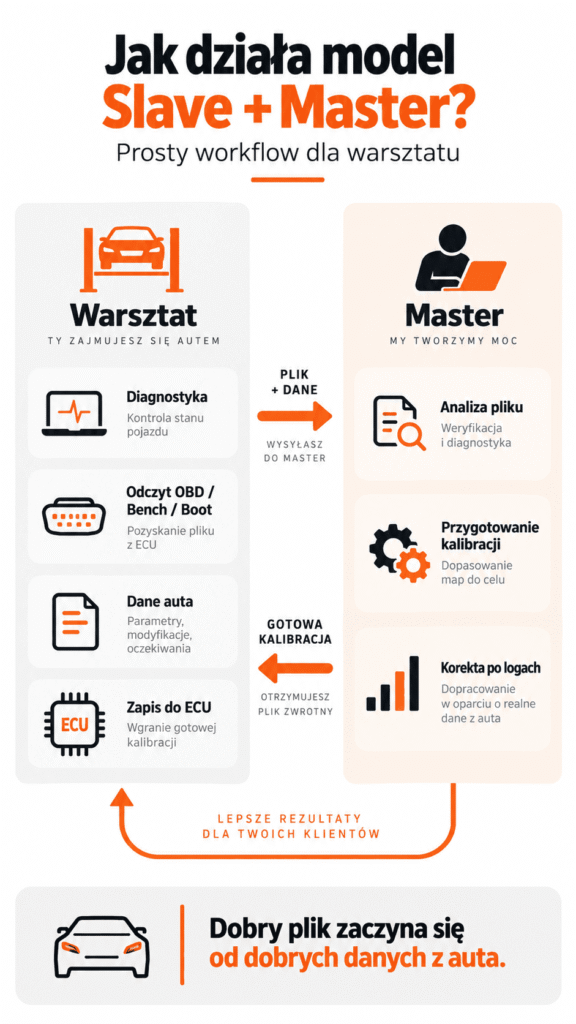
Magic Motorsport also allows FLEX Master users to build their own Slave network. According to the manufacturer's documentation, a single Master can manage many assigned Slave users, and file operations are handled within its ecosystem. [5]
What does this mean for the workshop?
You don't need to know the structure of every calibration right away.
However, you do need to understand what happens to the car before and after it is changed.
These are two different skill sets.
The calibrator is responsible for the file. The workshop should still be able to assess whether the car is suitable for modification at all and whether it runs properly after writing.
Szarbi expert advice: treat your file supplier as part of the technical process, not as a machine you feed every read into. A good Master should be able to ask for logs, clarify the car's configuration and refuse an aggressive modification if the data points to a technical problem.
What chip tuning equipment do you need to get started?
A programmer alone is not enough. You also need basic diagnostic equipment and a stable workstation for working on ECUs and TCUs.
The minimum kit depends on the vehicles you want to work on, but it is usually worth including:
- a genuine ECU/TCU programmer,
- a computer that meets the tool manufacturer's requirements,
- a stabilised power supply,
- a diagnostic tester or interface,
- OBD cables,
- Bench cables and adapters,
- Boot equipment, if you plan to carry out such operations,
- basic tools for safely removing the ECU,
- access to a reliable file service provider.
In the SZARBI range you will find both diagnostic tools and solutions for reading and writing control units.
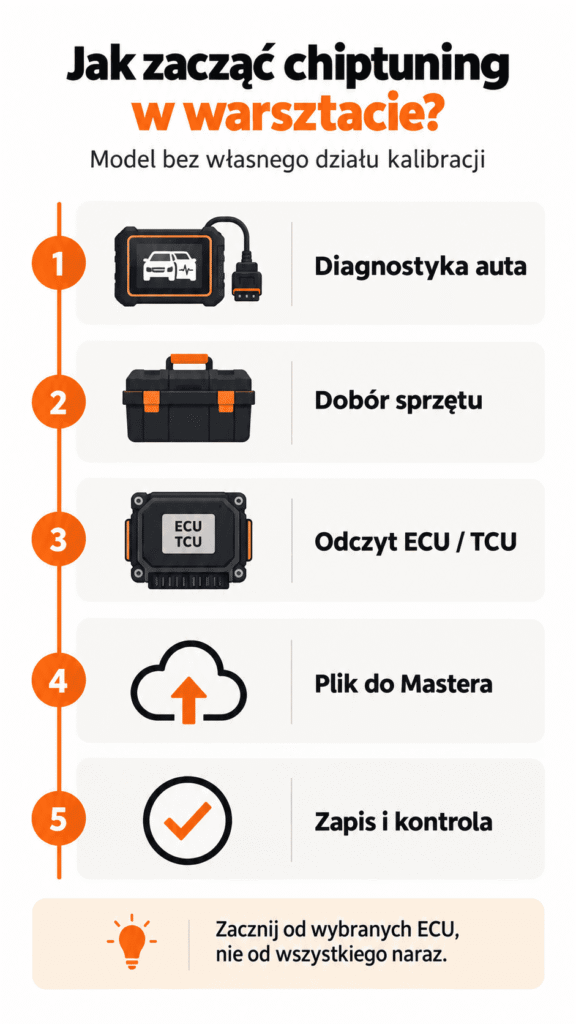
However, don't buy a kit based on the "the more cables, the better" principle. First, check which cars actually come into your workshop.
Which Slave programmer should you choose to start with?
Your choice should be based on the list of ECUs and TCUs you actually plan to work on.
Two popular options are AutoTuner Slave and FLEX Slave.
AutoTuner Slave
AutoTuner supports ECUs and TCUs via OBD, Bench and Boot. The software guides the user through the procedures, showing how to connect and which accessories are required. [3]
In the Slave version:
- files are encrypted,
- the device is assigned to a Master,
- the Master prepares the file for writing,
- subsequently changing the Master or upgrading to Master is subject to the manufacturer's procedure. [1][6]
AutoTuner also lets you upgrade from Slave to Master later on. According to current documentation, the consent of the current Master is required. The manufacturer also states that after reassignment, previously read files and backups may no longer be compatible with the device. [6]
This matters if you are building an archive of your customers' vehicles.
FLEX Slave
FLEX is also available in a Slave version and supports various ECU, TCU, OBD, Bench and Boot configurations depending on the package you own. [5]
The model is more modular.
You can choose packages to suit your specific scope of work. Magic Motorsport offers, among others, ECU, Full and Heavy-Duty configurations, as well as packages for specific processor or vehicle groups. [5][7]
A FLEX Slave user:
- works on encrypted files,
- is assigned to a FLEX Master,
- cannot edit files independently,
- sends files to their Master when modifications are needed. [5]
This does not mean that one solution is automatically better. Check your own list of control units.
How do you choose a good Master or ECU file provider?
What matters most is technical expertise and the quality of support after the first version of the file is delivered.
The price of a single file is just one of the factors.
Before assigning a Slave programmer, it is worth finding out:
- which ECUs and TCUs the provider works with most often,
- what the standard file turnaround time is,
- whether they analyse logs,
- whether they make corrections after the first write,
- what the support hours are,
- whether they handle unusual mechanical configurations,
- whether they archive stock and modified files,
- how they resolve problems after an interrupted write,
- whether they can tell you when a car should not be modified.
In practice, communication is just as important.
If you only provide the car make, engine displacement and the expected gain, the Master has too little data.
Provide at least the correct ECU identification, the software version and any information relevant to the specific car.
What does diagnostics look like before chiptuning?
Before reading and writing, you need to confirm that the car has no problem that a higher load could simply bring to the surface.
There is no single, identical checklist for every car.
Depending on the engine, it is worth checking, among other things:
- stored DTC,
- boost parameters,
- fuel pressure,
- temperatures,
- airflow,
- injection corrections,
- lambda,
- ignition corrections in a petrol engine,
- DPF condition, if fitted,
- cooling system operation,
- clutch or gearbox behaviour.
An ECU programmer is no substitute for diagnostics.
That is why getting into chiptuning without doing your own calibration does not mean you can skip knowledge of car mechanics.
In everyday workshop practice: a car with a boost control fault should not be "fixed with tuning". First you diagnose the cause of the problem. Only a healthy car is the starting point for further work.
What does a typical job look like step by step?
Let's assume a stock turbodiesel with an ECU from the popular Bosch family arrives at the workshop.
The car shows no faults, and the customer wants to improve the torque characteristics.
1. Diagnostics
First, you read the fault codes and check the engine's operating parameters.
If there are any irregularities, you don't move on just because the programmer can handle the ECU.
2. ECU identification
You check:
- the ECU manufacturer,
- the ECU family,
- the hardware,
- software,
- available protocols.
3. Choosing OBD, Bench or Boot
If the device supports the relevant operation via OBD, there is no need to remove the ECU by default.
If the required scope is only available on Bench, you work with the ECU on the bench.
You use Boot when a specific procedure requires it.
4. Reading
You create the file according to the programmer's instructions.
In AutoTuner, the read can be real or virtual depending on the ECU and protocol. [3]
5. The file goes to the Master
You pass on the vehicle identification, the customer's requirements and relevant diagnostic data.
The Master prepares the calibration.
6. Writing and verification
You write the received file to the ECU according to the procedure.
Then you check the DTCs and operating parameters again.
If necessary, you record logs and send them to the person preparing the calibration.
It is this final stage that sets a professional workshop service apart from randomly "flashing a ready-made file".
Can you sell chiptuning without your own dyno?
Yes, but not having a dyno does not exempt you from the need to technically verify the vehicle.
A dyno is a measuring tool.
Among other things, it lets you compare torque and power curves before and after the change under conditions that are as similar as possible.
Not every workshop needs its own dyno from day one.
You can work with an external measuring facility or carry out additional diagnostics and datalogging where the procedure for a given vehicle allows it.
However, you should not promise the customer a specific HP or Nm figure that you have not measured.
How much knowledge do you need with a Slave programmer?
A Slave reduces the need to edit maps yourself, but it does not eliminate the need to understand the ECU programming process.
You should know:
- the difference between an ECU and a TCU,
- what Flash and EEPROM are,
- the difference between Normal Read and Virtual Read,
- when to use OBD, Bench and Boot,
- how to ensure a stable power supply,
- what a backup is,
- how recovery works,
- what diagnostic data is worth collecting,
- how to avoid mixing up ECU versions,
- when to abort the job.
A well-chosen Master can help with the calibration.
However, they won't be standing next to the car and won't check for you whether the wire has been connected to the right pin.
Can you later switch from Slave to doing your own calibrations?
Yes. The Slave model can be a transitional stage before the workshop develops its own calibration expertise.
At first, you can focus on:
- operating the programmer,
- diagnosing vehicles,
- getting to know ECU families,
- logging parameters,
- building a repeatable process.
Only later do you move on to learning your own calibration.
With AutoTuner, it is possible to switch from Slave to Master once the manufacturer's requirements are met. [6]
With FLEX, you can also work in the Master or Slave model, depending on the licence you choose. [5]
However, this does not mean that simply switching to Master makes you a calibrator.
You still need the right software, knowledge of control strategies and hands-on experience.
What are the most common mistakes workshops make at the beginning?
The biggest problem is treating the programmer as a "read → send → write" device.
No diagnostics
If a car already has an issue with the turbocharger, fuel system or temperatures from the factory, tuning can put even more strain on the faulty component.
The cheapest Master
A low file price means little if a revision takes two days, nobody analyses the logs, or you receive the same calibration regardless of the car's configuration.
No backup
Before you write anything, check the recovery options for the specific ECU.
Promising results without measurement
Don't promise a customer "+30 HP" upfront if you have no data on the specific car and no subsequent measurement.
Too broad an offering at the start
It's better to handle a specific group of ECUs properly than to advertise "chiptuning for all cars".
How do you build a chiptuning service in a workshop from scratch?
The safest approach is to start with a limited range of vehicles, a good Slave programmer and one trusted Master partner.
A practical plan might look like this:
- Analyse the cars that already come into your workshop.
- Check their ECUs and TCUs on the Vehicle List of the chosen programmer.
- Choose the Slave version.
- Establish cooperation with a Master.
- Set up a diagnostic station.
- Learn OBD, Bench and the basics of Boot.
- Build a diagnostic procedure to carry out before the service.
- Prepare a form for the data to be sent to the calibrator.
- Archive all stock files and job documentation.
- Expand the range of supported ECUs only once your initial scope of work is repeatable.
Ready-made ECU files can be part of this process if they are prepared by a qualified specialist and matched to the specific version of the control unit. However, simply having a file is no substitute for identifying the ECU and diagnosing the car.
FAQ – how to start chiptuning in a workshop?
Launching the service without your own calibration department is possible, but it still requires the right technical resources. The questions below cover the most common concerns at the start.
Do I need to know WinOLS to do chiptuning?
No, if you use a Slave tool and outsource calibration to a Master. However, you still need knowledge of diagnostics, ECUs and safe tool operation.
Is a Slave tool enough to start offering the service?
It can form the core of your workstation, but you also need diagnostic equipment, a stable power supply and a partner to prepare the files.
Can a Slave tool read the ECU via OBD?
Yes, if the tool and protocol support that specific ECU via OBD. Slave status alone does not limit you to a single communication method. [3][5]
Does a Slave tool support Bench and Boot?
AutoTuner and FLEX offer Slave solutions that also use Bench and Boot in supported configurations. Coverage should be checked for the specific ECU. [3][5]
Can I send a Slave file to any tuner?
No. The file is encrypted and tied to a specific Master. [1][5]
Can I change my Master later?
It depends on the ecosystem and the manufacturer's procedure. AutoTuner allows a change once the current Master releases the device. [6] FLEX also requires the Master's consent to release the assigned Slave. [5]
Is an in-house calibration department profitable from the start?
Not always. It depends on job volume, software costs, staff experience and the range of ECUs supported. The Slave model lets you build the workshop side of the process first.
Can I offer chiptuning without a dyno?
Yes, but you shouldn't present an unmeasured result as fact. You can also use an external dyno.
Is the Master responsible for the safety of the entire service?
No. The Master is responsible for the file they prepare, but the vehicle's condition, correct connection, writing and diagnostics remain part of the workshop's job.
Is it worth starting with all makes?
It's usually more practical to start with the group of vehicles and ECUs you already service regularly. That makes it easier to build a repeatable process.
Sources:
[1] AutoTuner Help Center, What’s the difference between Master Tool and Slave Tool?, accessed: 21.09.2026
URL: https://help.autotuner.com/en/articles/2984985-what-s-the-difference-between-master-tool-and-slave-tool
[2] AutoTuner Help Center, How-to decrypt slave files and backup, accessed: 21.09.2026
URL: https://help.autotuner.com/en/articles/2984977-how-to-decrypt-slave-files-and-backup
[3] AutoTuner, AutoTuner Tool – ECU/TCU, OBD, Bench, Boot, Master and Slave, accessed: 21.09.2026
URL: https://www.autotuner.com/products/autotuner-tool
[4] AutoTuner Help Center, Files formats – Master, Slave and Backup, accessed: 21.09.2026
URL: https://help.autotuner.com/en/articles/2984768-files-formats
[5] Magic Motorsport, FLEX – Master and Slave, Vehicle List, software and workflow, accessed: 21.09.2026
URL: https://www.magicmotorsport.com/en/flex/
[6] AutoTuner Help Center, Slave tool transfer or upgrade to Master, accessed: 21.09.2026
URL: https://help.autotuner.com/en/articles/3711001-slave-tool-transfer-or-upgrade-to-master
[7] Magic Motorsport, Flex GSAP – package and license configuration, accessed: 21.09.2026
URL: https://www.magicmotorsport.com/en/flex-gsap/


